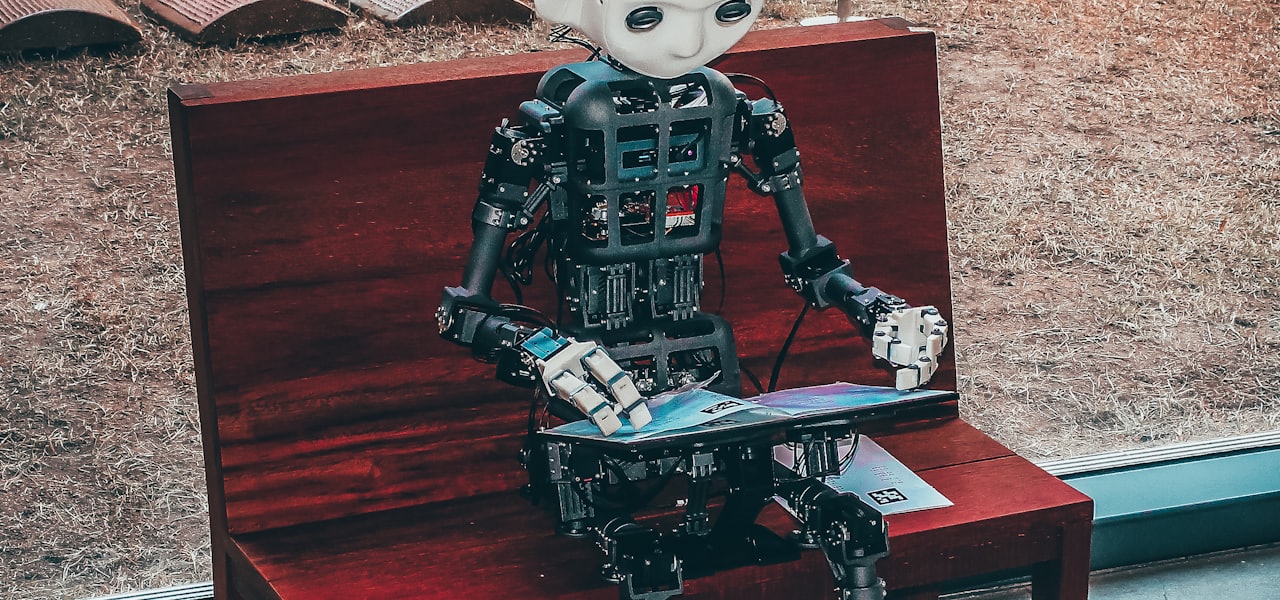
Virtual intelligence (VI) is the term given to artificial intelligence that exists within a virtual world. Many virtual worlds have options for persistent avatars that provide information, training, role-playing, and social interactions. The immersion in virtual worlds provides a platform for VI beyond the traditional paradigm of past user interfaces (UIs). What Alan Turing established as a benchmark for telling the difference between human and computerized intelligence was devoid of visual influences. With today's VI bots, virtual intelligence has evolved past the constraints of past testing into a new level of the machine's ability to demonstrate intelligence. The immersive features of these environments provide nonverbal elements that affect the realism provided by virtually intelligent agents. Virtual intelligence is the intersection of these two technologies: Virtual environments: Immersive 3D spaces provide for collaboration, simulations, and role-playing interactions for training. Many of these virtual environments are currently being used for government and academic projects, including Second Life, VastPark, Olive, OpenSim, Outerra, Oracle's Open Wonderland, Duke University's Open Cobalt, and many others. Some of the commercial virtual worlds are also taking this technology into new directions, including the high-definition virtual world Blue Mars. Artificial intelligence (AI): AI is a branch of computer science that aims to create intelligent machines capable of performing tasks that typically require human intelligence. VI is a type of AI that operates within virtual environments to simulate human-like interactions and responses. == Applications == Cutlass Bomb Disposal Robot: Northrop Grumman developed a virtual training opportunity because of the prohibitive real-world cost and dangers associated with bomb disposal. By replicating a complicated system without having to learn advanced code, the virtual robot has no risk of damage, trainee safety hazards, or accessibility constraints. MyCyberTwin: NASA is among the companies that have used the MyCyberTwin AI technologies. They used it for the Phoenix rover in the virtual world Second Life. Their MyCyberTwin used a programmed profile to relay information about what the Phoenix rover was doing and its purpose. Second China: The University of Florida developed the "Second China" project as an immersive training experience for learning how to interact with the culture and language in a foreign country. Students are immersed in an environment that provides role-playing challenges coupled with language and cultural sensitivities magnified during country-level diplomatic missions or during times of potential conflict or regional destabilization. The virtual training provides participants with opportunities to access information, take part in guided learning scenarios, communicate, collaborate, and role-play. While China was the country for the prototype, this model can be modified for use with any culture to help better understand social and cultural interactions and see how other people think and what their actions imply. Duke School of Nursing Training Simulation: Extreme Reality developed virtual training to test critical thinking with a nurse performing trained procedures to identify critical data to make decisions and performing the correct steps for intervention. Bots are programmed to respond to the nurse's actions as the patient with their conditions improving if the nurse performs the correct actions.
Artificial consciousness
Artificial consciousness, also known as machine consciousness, synthetic consciousness, or digital consciousness, is consciousness hypothesized to be possible for artificial intelligence. It is also the corresponding field of study, which draws insights from philosophy of mind, philosophy of artificial intelligence, cognitive science and neuroscience. The term "sentience" can be used when specifically designating ethical considerations stemming from a form of phenomenal consciousness (P-consciousness, or the ability to feel qualia). Since sentience involves the ability to experience ethically positive or negative (i.e., valenced) mental states, it may justify welfare concerns and legal protection, as with non-human animals. Some scholars believe that consciousness is generated by the interoperation of various parts of the brain; these mechanisms are labeled the neural correlates of consciousness (NCC). Some further believe that constructing a system (e.g., a computer system) that can emulate this NCC interoperation would result in a system that is conscious. Some scholars reject the possibility of non-biological conscious beings. == Philosophical views == As there are many hypothesized types of consciousness, there are many potential implementations of artificial consciousness. In the philosophical literature, perhaps the most common taxonomy of consciousness is into "access" and "phenomenal" variants. Access consciousness concerns those aspects of experience that can be apprehended, while phenomenal consciousness concerns those aspects of experience that seemingly cannot be apprehended, instead being characterized qualitatively in terms of "raw feels", "what it is like" or qualia. === Plausibility debate === Type-identity theorists and other skeptics hold the view that consciousness can be realized only in particular physical systems because consciousness has properties that necessarily depend on physical constitution. In his 2001 article "Artificial Consciousness: Utopia or Real Possibility," Giorgio Buttazzo says that a common objection to artificial consciousness is that, "Working in a fully automated mode, they [the computers] cannot exhibit creativity, unreprogrammation (which means can 'no longer be reprogrammed', from rethinking), emotions, or free will. A computer, like a washing machine, is a slave operated by its components." For other theorists (e.g., functionalists), who define mental states in terms of causal roles, any system that can instantiate the same pattern of causal roles, regardless of physical constitution, will instantiate the same mental states, including consciousness. ==== Thought experiments ==== David Chalmers proposed two thought experiments intending to demonstrate that "functionally isomorphic" systems (those with the same "fine-grained functional organization", i.e., the same information processing) will have qualitatively identical conscious experiences, regardless of whether they are based on biological neurons or digital hardware. The "fading qualia" is a reductio ad absurdum thought experiment. It involves replacing, one by one, the neurons of a brain with a functionally identical component, for example based on a silicon chip. Chalmers makes the hypothesis, knowing it in advance to be absurd, that "the qualia fade or disappear" when neurons are replaced one-by-one with identical silicon equivalents. Since the original neurons and their silicon counterparts are functionally identical, the brain's information processing should remain unchanged, and the subject's behaviour and introspective reports would stay exactly the same. Chalmers argues that this leads to an absurd conclusion: the subject would continue to report normal conscious experiences even as their actual qualia fade away. He concludes that the subject's qualia actually don't fade, and that the resulting robotic brain, once every neuron is replaced, would remain just as sentient as the original biological brain. Similarly, the "dancing qualia" thought experiment is another reductio ad absurdum argument. It supposes that two functionally isomorphic systems could have different perceptions (for instance, seeing the same object in different colors, like red and blue). It involves a switch that alternates between a chunk of brain that causes the perception of red, and a functionally isomorphic silicon chip, that causes the perception of blue. Since both perform the same function within the brain, the subject would not notice any change during the switch. Chalmers argues that this would be highly implausible if the qualia were truly switching between red and blue, hence the contradiction. Therefore, he concludes that the equivalent digital system would not only experience qualia, but it would perceive the same qualia as the biological system (e.g., seeing the same color). Greg Egan's short story Learning To Be Me (mentioned in §In fiction), illustrates how undetectable duplication of the brain and its functionality could be from a first-person perspective. Critics object that Chalmers' proposal begs the question in assuming that all mental properties and external connections are already sufficiently captured by abstract causal organization. Van Heuveln et al. argue that the dancing qualia argument contains an equivocation fallacy, conflating a "change in experience" between two systems with an "experience of change" within a single system. Mogensen argues that the fading qualia argument can be resisted by appealing to vagueness at the boundaries of consciousness and the holistic structure of conscious neural activity, which suggests consciousness may require specific biological substrates rather than being substrate-independent. Anil Seth argues that the complexity of brain neurons intrinsically matters in addition to their function and that it is not possible to replace any part of the brain with a perfect silicon equivalent. He points out that some of biological neurons exhibit activity aimed at cleaning up metabolic waste products, and writes that a perfect silicon replacement would require a silicon-based metabolism, but silicon is not suitable for creating such artificial metabolism. ==== In large language models ==== In 2022, Google engineer Blake Lemoine made a viral claim that Google's LaMDA chatbot was sentient. Lemoine supplied as evidence the chatbot's humanlike answers to many of his questions; however, the chatbot's behavior was judged by the scientific community as likely a consequence of mimicry, rather than machine sentience. Lemoine's claim was widely derided for being ridiculous. Moreover, attributing consciousness based solely on the basis of LLM outputs or the immersive experience created by an algorithm is considered a fallacy. However, while philosopher Nick Bostrom states that LaMDA is unlikely to be conscious, he additionally poses the question of "what grounds would a person have for being sure about it?" One would have to have access to unpublished information about LaMDA's architecture, and also would have to understand how consciousness works, and then figure out how to map the philosophy onto the machine: "(In the absence of these steps), it seems like one should be maybe a little bit uncertain. [...] there could well be other systems now, or in the relatively near future, that would start to satisfy the criteria." David Chalmers argued in 2023 that LLMs today display impressive conversational and general intelligence abilities, but are likely not conscious yet, as they lack some features that may be necessary, such as recurrent processing, a global workspace, and unified agency. Nonetheless, he considers that non-biological systems can be conscious, and suggested that future, extended models (LLM+s) incorporating these elements might eventually meet the criteria for consciousness, raising both profound scientific questions and significant ethical challenges. However, the view that consciousness can exist without biological phenomena is controversial and some reject it. Kristina Šekrst cautions that anthropomorphic terms such as "hallucination" can obscure important ontological differences between artificial and human cognition. While LLMs may produce human-like outputs, she argues that it does not justify ascribing mental states or consciousness to them. Instead, she advocates for an epistemological framework (such as reliabilism) that recognizes the distinct nature of AI knowledge production. She suggests that apparent understanding in LLMs may be a sophisticated form of AI hallucination. She also questions what would happen if an LLM were trained without any mention of consciousness. === Testing === Sentience is an inherently first-person phenomenon. Because of that, and due to the lack of an empirical definition of sentience, directly measuring it may be impossible. Although systems may display numerous behaviors correlated with sentience, determining whether a system is sentient is known as the hard pr
AUTINDEX
AUTINDEX is a commercial text mining software package based on sophisticated linguistics. AUTINDEX, resulting from research in information extraction, is a product of the Institute of Applied Information Sciences (IAI) which is a non-profit institute that has been researching and developing language technology since its foundation in 1985. IAI is an institute affiliated to Saarland University in Saarbrücken, Germany. AUTINDEX is the result of a number of research projects funded by the EU (Project BINDEX), by Deutsche Forschungsgemeinschaft and the German Ministry for Economy. Amongst the latter there are the projects LinSearch, and WISSMER, see also the reference to IAI-Website. The basic functionality of AUTINDEX is the extraction of key words from a document to represent the semantics of the document. Ideally the system is integrated with a thesaurus that defines the standardised terms to be used for key word assignment. AUTINDEX is used in library applications (e.g. integrated in dandelon.com) as well as in high quality (expert) information systems, and in document management and content management environments. Together with AUTINDEX a number of additional software comes along such as an integration with Apache Solr / Lucene to provide a complete information retrieval environment, a classification and categorisation system on the basis of a machine learning software that assigns domains to the document, and a system for searching with semantically similar terms that are collected in so called tag clouds.
Neural processing unit
A neural processing unit (NPU), also known as an AI accelerator or deep learning processor, is a class of specialized hardware accelerator or computer system designed to accelerate artificial intelligence and machine learning applications, including artificial neural networks and computer vision. == Use == Their purpose is either to efficiently execute already trained AI models (inference) or to train AI models. NPUs can be more efficient in terms of speed or power consumption. NPU applications include algorithms for robotics, Internet of things, and data-intensive or sensor-driven tasks. They are often manycore or spatial designs and focus on low-precision arithmetic, novel dataflow architectures, or in-memory computing capability. As of 2024, a widely used datacenter-grade AI integrated circuit chip, the Nvidia H100 GPU, contains tens of billions of MOSFETs. === Consumer devices === AI accelerators are used in Apple silicon, Qualcomm, Samsung, Huawei, and Google Tensor smartphone processors. Vision processing units are accelerators specialized for machine vision algorithms such as CNN (convolutional neural networks) and SIFT (scale-invariant feature transform). They are used in devices that need to keep track of objects visually such as AR headsets and drones. It is more recently (circa 2017) added to processors from Apple and (circa 2022) to processors from Intel and AMD. All models of Intel Meteor Lake processors have a built-in versatile processor unit (VPU) for accelerating inference for computer vision and deep learning. On consumer devices, the NPU is intended to be small, power-efficient, but reasonably fast when used to run small models. To do this they are designed to support low-bitwidth operations using data types such as INT4, INT8, FP8, and FP16. A common metric is trillions of operations per second (TOPS). Although TOPS does not explicitly specify the kind of operations, it is typically INT8 additions and multiplications. === Datacenters === Accelerators are used in cloud computing servers: e.g., tensor processing units (TPU) for Google Cloud Platform, and Trainium and Inferentia chips for Amazon Web Services. Many vendor-specific terms exist for devices in this category, and it is an emerging technology without a dominant design. Since the late 2010s, graphics processing units designed by companies such as Nvidia and AMD often include AI-specific hardware in the form of dedicated functional units for low-precision matrix-multiplication operations. These GPUs are commonly used as AI accelerators, both for training and inference. === Scientific computation === Although NPUs are tailored for low-precision (e.g., FP16, INT8) matrix multiplication operations, they can be used to emulate higher-precision matrix multiplications in scientific computing. As modern GPUs place much focus on making the NPU part fast, using emulated FP64 (Ozaki scheme) on NPUs can potentially outperform native FP64. This has been demonstrated using FP16-emulated FP64 on NVIDIA TITAN RTX and using INT8-emulated FP64 on NVIDIA consumer GPUs and the A100 GPU. Consumer GPUs especially benefited as they have limited FP64 hardware capacity, showing a 6× speedup. Since CUDA Toolkit 13.0 Update 2, cuBLAS automatically uses INT8-emulated FP64 matrix multiplication of the equivalent precision if it is faster than native. This is in addition to the FP16-emulated FP32 feature introduced in version 12.9. == Programming == An operating system or a higher-level library may provide application programming interfaces such as TensorFlow with LiteRT Next (Android), CoreML (iOS, macOS) or DirectML (Windows). Formats such as ONNX are used to represent trained neural networks. Consumer CPU-integrated NPUs are accessible through vendor-specific APIs. AMD (Ryzen AI), Intel (OpenVINO), Apple silicon (CoreML), and Qualcomm (SNPE) each have their own APIs, which can be built upon by a higher-level library. GPUs generally use existing GPGPU pipelines such as CUDA and OpenCL adapted for lower precisions and specialized matrix-multiplication operations. Vulkan is also being used. Custom-built systems such as the Google TPU use private interfaces. There are a large number of separate underlying acceleration APIs and compilers/runtimes in use in the AI field, causing a great increase in software development effort due to the many combinations involved. As of 2025, the open standard organization Khronos Group is pursuing standardization of AI-related interfaces to reduce the amount of work needed. Khronos is working on three separate fronts: expansion of data types and intrinsic operations in OpenCL and Vulkan, inclusion of compute graphs in SPIR-V, and a NNEF/SkriptND file format for describing a neural network.
PARRY
PARRY was an early example of a chatbot, implemented in 1972 by psychiatrist Kenneth Colby. == History == PARRY was written in 1972 by psychiatrist Kenneth Colby, then at Stanford University. While ELIZA was a simulation of a Rogerian therapist, PARRY attempted to simulate a person with paranoid schizophrenia. The program implemented a crude model of the behavior of a person with paranoid schizophrenia based on concepts, conceptualizations, and beliefs (judgements about conceptualizations: accept, reject, neutral). It also embodied a conversational strategy, and as such was a much more serious and advanced program than ELIZA. It was described as "ELIZA with attitude". PARRY was tested in the early 1970s using a variation of the Turing Test. A group of experienced psychiatrists analysed a combination of real patients and computers running PARRY through teleprinters. Another group of 33 psychiatrists were shown transcripts of the conversations. The two groups were then asked to identify which of the "patients" were human and which were computer programs. The psychiatrists were able to make the correct identification only 48 percent of the time — a figure consistent with random guessing. PARRY and ELIZA (also known as "the Doctor") interacted several times. The most famous of these exchanges occurred at the ICCC 1972, where PARRY and ELIZA were hooked up over ARPANET and responded to each other.
Nouvelle AI
Nouvelle artificial intelligence (Nouvelle AI) is an approach to artificial intelligence pioneered in the 1980s by Rodney Brooks, who was then part of MIT artificial intelligence laboratory. Nouvelle AI differs from classical AI by aiming to produce robots with intelligence levels similar to insects. Researchers believe that intelligence can emerge organically from simple behaviors as these intelligences interacted with the "real world", instead of using the constructed worlds which symbolic AIs typically needed to have programmed into them. == Motivation == The differences between nouvelle AI and symbolic AI are apparent in early robots Shakey and Freddy. These robots contained an internal model (or "representation") of their micro-worlds consisting of symbolic descriptions. As a result, this structure of symbols had to be renewed as the robot moved or the world changed. Shakey's planning programs assessed the program structure and broke it down into the necessary steps to complete the desired action. This level of computation required a large amount time to process, so Shakey typically performed its tasks very slowly. Symbolic AI researchers had long been plagued by the problem of updating, searching, and otherwise manipulating the symbolic worlds inside their AIs. A nouvelle system refers continuously to its sensors rather than to an internal model of the world. It processes the external world information it needs from the senses when it is required. As Brooks puts it, "the world is its own best model--always exactly up to date and complete in every detail." A central idea of nouvelle AI is that simple behaviors combine to form more complex behaviors over time. For example, simple behaviors can include elements like "move forward" and "avoid obstacles." A robot using nouvelle AI with simple behaviors like collision avoidance and moving toward a moving object could possibly come together to produce a more complex behavior like chasing a moving object. === The frame problem === The frame problem describes an issue with using first-order logic (FOL) to express facts about a robot in the world. Representing the state of a robot with traditional FOL requires the use of many axioms (symbolic language) to imply that things about an environment do not change arbitrarily. Nouvelle AI seeks to sidestep the frame problem by dispensing with filling the AI or robot with volumes of symbolic language and instead letting more complex behaviors emerge by combining simpler behavioral elements. === Embodiment === The goal of traditional AI was to build intelligences without bodies, which would only have been able to interact with the world via keyboard, screen, or printer. However, nouvelle AI attempts to build embodied intelligence situated in the real world. Brooks quotes approvingly from the brief sketches that Turing gave in 1948 and 1950 of the "situated" approach. Turing wrote of equipping a machine "with the best sense organs that money can buy" and teaching it "to understand and speak English" by a process that would "follow the normal teaching of a child." This approach was contrasted to the others where they focused on abstract activities such as playing chess. == Brooks' robots == === Insectoid robots === Brooks focused on building robots that acted like simple insects while simultaneously working to remove some traditional AI characteristics. He created insect-like robots, named Allen and Herbert after cognitive science and AI pioneers Allen Newell and Herbert A. Simon. Brooks's insectoid robots contained no internal models of the world. Herbert, for example, discarded a high volume of the information received from its sensors and never stored information for more than two seconds. ==== Allen ==== Allen had a ring of twelve ultrasonic sonars as its primary sensors and three independent behavior-producing modules. These modules were programmed to avoid both stationary and moving objects. With only this module activated, Allen stayed in the middle of a room until an object approached and then it ran away while avoiding obstacles in its way. ==== Herbert ==== Herbert used infrared sensors to avoid obstacles and a laser system to collect 3D data over a distance of about 12 feet. Herbert also carried a number of simple sensors in its "hand." The robot's testing ground was the real world environment of the busy offices and workspaces of the MIT AI lab where it searched for empty soda cans and carried them away, a seemingly goal-oriented activity that emerged as a result of 15 simple behavior units combining. As a parallel, Simon noted that an ant's complicated path is due to the structure of its environment rather than the depth of its thought processes. ==== Other insectoid robots ==== Other robots by Brooks' team were Genghis and Squirt. Genghis had six legs and was able to walk over rough terrain and follow a human. Squirt's behavior modules had it stay in dark corners until it heard a noise, then it would begin to follow the source of the noise. Brooks agreed that the level of nouvelle AI had come near the complexity of a real insect, which raised a question about whether or not insect level-behavior was and is a reasonable goal for nouvelle AI. === Humanoid robots === Brooks' own recent work has taken the opposite direction to that proposed by Von Neumann in the quotations "theorists who select the human nervous system as their model are unrealistically picking 'the most complicated object under the sun,' and that there is little advantage in selecting instead the ant, since any nervous system at all exhibits exceptional complexity." ==== Cog ==== In the 1990s, Brooks decided to pursue the goal of human-level intelligence and, with Lynn Andrea Stein, built a humanoid robot called Cog. Cog is a robot with an extensive collection of sensors, a face, and arms (among other features) that allow it to interact with the world and gather information and experience so as to assemble intelligence organically in the manner described above by Turing. The team believed that Cog would be able to learn and able to find a correlation between the sensory information it received and its actions, and to learn common sense knowledge on its own. As of 2003, all development of the project had ceased.
Virtual assistant
A virtual assistant (VA) is a software agent that can perform a range of tasks or services for a user based on user input, such as commands or questions, including verbal ones. Such technologies often incorporate chatbot capabilities to streamline task execution. The interaction may be via text, graphical interface, or voice, as some virtual assistants are able to interpret human speech and respond via synthesized voices. In many cases, users can ask their virtual assistants questions, control home automation devices and media playback, and manage other basic tasks such as email, to-do lists, and calendars – all with verbal commands. In recent years, prominent virtual assistants for direct consumer use have included Apple Siri, Amazon Alexa, Google Assistant (Gemini), Microsoft Copilot and Samsung Bixby. Also, companies in various industries often incorporate some kind of virtual assistant technology into their customer service or support. Into the 2020s, the emergence of artificial intelligence based chatbots, such as ChatGPT, has brought increased capability and interest to the field of virtual assistant products and services. == History == === Experimental decades: 1910s–1980s === Radio Rex was the first voice-activated toy, patented in 1916 and released in 1922. It was a wooden toy in the shape of a dog that would come out of its house when its name is called. In 1952, Bell Labs presented "Audrey", the Automatic Digit Recognition machine. It occupied a six-foot-high relay rack, consumed substantial power, had streams of cables and exhibited the myriad maintenance problems associated with complex vacuum-tube circuitry. It could recognize the fundamental units of speech, phonemes. It was limited to the accurate recognition of digits spoken by designated talkers. It could therefore be used for voice dialing, but in most cases, push-button dialing was cheaper and faster, rather than speaking the consecutive digits. Another early tool which was enabled to perform digital speech recognition was the IBM Shoebox voice-activated calculator, presented to the general public during the 1962 Seattle World's Fair after its initial market launch in 1961. This early computer, developed almost 20 years before the introduction of the first IBM Personal Computer in 1981, was able to recognize 16 spoken words and the digits 0 to 9. The first natural language processing computer program or the chatbot ELIZA was developed by MIT professor Joseph Weizenbaum in the 1960s. It was created to "demonstrate that the communication between man and machine was superficial". ELIZA used pattern matching and substitution methodology into scripted responses to simulate conversation, which gave an illusion of understanding on the part of the program. Weizenbaum's own secretary reportedly asked Weizenbaum to leave the room so that she and ELIZA could have a real conversation. Weizenbaum was surprised by this, later writing: "I had not realized ... that extremely short exposures to a relatively simple computer program could induce powerful delusional thinking in quite normal people. This gave name to the ELIZA effect, the tendency to unconsciously assume computer behaviors are analogous to human behaviors; that is, anthropomorphisation, a phenomenon present in human interactions with virtual assistants. The next milestone in the development of voice recognition technology was achieved in the 1970s at the Carnegie Mellon University in Pittsburgh, Pennsylvania with substantial support of the United States Department of Defense and its DARPA agency, funded five years of a Speech Understanding Research program, aiming to reach a minimum vocabulary of 1,000 words. Companies and academia including IBM, Carnegie Mellon University (CMU) and Stanford Research Institute took part in the program. The result was "Harpy", it mastered about 1000 words, the vocabulary of a three-year-old and it could understand sentences. It could process speech that followed pre-programmed vocabulary, pronunciation, and grammar structures to determine which sequences of words made sense together, and thus reducing speech recognition errors. In 1986, Tangora was an upgrade of the Shoebox, it was a voice recognizing typewriter. Named after the world's fastest typist at the time, it had a vocabulary of 20,000 words and used prediction to decide the most likely result based on what was said in the past. IBM's approach was based on a hidden Markov model, which adds statistics to digital signal processing techniques. The method makes it possible to predict the most likely phonemes to follow a given phoneme. Still each speaker had to individually train the typewriter to recognize their voice, and pause between each word. In 1983, Gus Searcy invented the "Butler in a Box", an electronic voice home controller system. === Birth of smart virtual assistants: 1990s–2010s === In the 1990s, digital speech recognition technology became a feature of the personal computer with IBM, Philips and Lernout & Hauspie fighting for customers. Much later the market launch of the first smartphone IBM Simon in 1994 laid the foundation for smart virtual assistants as we know them today. In 1997, Dragon's NaturallySpeaking software could recognize and transcribe natural human speech without pauses between each word into a document at a rate of 100 words per minute. A version of Naturally Speaking is still available for download and it is still used today, for instance, by many doctors in the US and the UK to document their medical records. In 2001 Colloquis publicly launched SmarterChild, on platforms like AIM and MSN Messenger. While entirely text-based SmarterChild was able to play games, check the weather, look up facts, and converse with users to an extent. The first modern digital virtual assistant installed on a smartphone was Siri, which was introduced as a feature of the iPhone 4S on 4 October 2011. Apple Inc. developed Siri following the 2010 acquisition of Siri Inc., a spin-off of SRI International, which is a research institute financed by DARPA and the United States Department of Defense. Its aim was to aid in tasks such as sending a text message, making phone calls, checking the weather or setting up an alarm. Over time, it has developed to provide restaurant recommendations, search the internet, and provide driving directions. In November 2014, Amazon announced Alexa alongside the Echo. In 2016, Salesforce debuted Einstein, developed from a set of technologies underlying the Salesforce platform. Einstein was replaced by Agentforce, an agentic AI, in September 2024. In April 2017 Amazon released a service for building conversational interfaces for any type of virtual assistant or interface. === Large Language Models: 2020s-present === In the 2020s, artificial intelligence (AI) systems like ChatGPT have gained popularity for their ability to generate human-like responses to text-based conversations. In February 2020, Microsoft introduced its Turing Natural Language Generation (T-NLG), which was then the "largest language model ever published at 17 billion parameters." On November 30, 2022, ChatGPT was launched as a prototype and quickly garnered attention for its detailed responses and articulate answers across many domains of knowledge. The advent of ChatGPT and its introduction to the wider public increased interest and competition in the space. In February 2023, Google began introducing an experimental service called "Bard" which is based on its LaMDA program to generate text responses to questions asked based on information gathered from the web. While ChatGPT and other generalized chatbots based on the latest generative AI are capable of performing various tasks associated with virtual assistants, there are also more specialized forms of such technology that are designed to target more specific situations or needs. == Method of interaction == Virtual assistants work via: Text, including: online chat (especially in an instant messaging application or other application ), SMS text, e-mail or other text-based communication channel, for example Conversica's intelligent virtual assistants for business. Voice: for example with Amazon Alexa on Amazon Echo devices, Siri on an iPhone, Google Assistant on Google-enabled Android devices, or Bixby on Samsung devices. Images: some assistants, such as Google Assistant (which includes Google Lens) and Bixby on the Samsung Galaxy series, have the added capability of performing image processing to recognize objects in images. Many virtual assistants are accessible via multiple methods, offering versatility in how users can interact with them, whether through chat, voice commands, or other integrated technologies. Virtual assistants use natural language processing (NLP) to match user text or voice input to executable commands. Some continually learn using artificial intelligence techniques including machine learning and ambient intelligence. To activate a virtual assistant u