Representation collapse is a phenomenon in machine learning and representation learning where a model maps different inputs to the same or very similar embeddings, which means it loses important information about how the data is spread out. It is frequently encountered in self-supervised learning, especially within contrastive and non-contrastive frameworks, when training objectives or model architectures do not maintain variance across representations. Collapse results in degenerate solutions characterized by uninformative learned features, significantly impairing downstream task performance. Various techniques have been proposed to mitigate representation collapse, including the use of negative samples, architectural asymmetry, stop-gradient operations, variance regularization, and redundancy reduction objectives, as seen in methods such as SimCLR, BYOL, and VICReg. Comprehending and averting representation collapse is regarded as a fundamental challenge in the advancement of stable and efficient self-supervised learning systems.
Multimedia database
A Multimedia database (MMDB) is a collection of related for multimedia data. The multimedia data include one or more primary media data types such as text, images, graphic objects (including drawings, sketches and illustrations) animation sequences, audio and video. A Multimedia Database Management System (MMDBMS) is a framework that manages different types of data potentially represented in a wide diversity of formats on a wide array of media sources. It provides support for multimedia data types, and facilitate for creation, storage, access, query and control of a multimedia database. == Contents of MMDB == A Multimedia Database (MMDB) hosts one or more multimedia data types (i.e. text, images, graphic objects, audio, video, animation sequences). These data types are broadly categorized into three classes: Static media (time-independent: image and graphic object). Dynamic media (time-dependent: audio, video and animation). Dimensional media(3D game and computer aided drafting programs). === Comparison of multimedia data types === Additionally, a Multimedia Database (MMDB) needs to manage additional information pertaining to the actual multimedia data. The information is about the following: Media data: the actual data representing an object. Media format data: information about the format of the media data after it goes through the acquisition, processing, and encoding phases. Media keyword data: the keyword descriptions, usually relating to the generation of the media data. Media feature data: content dependent data such as contain information about the distribution of colours, the kinds of textures and the different shapes present in an image. The last three types are called metadata as they describe several different aspects of the media data. The media keyword data and media feature data are used as indices for searching purpose. The media format data is used to present the retrieved information. == Requirements of Multimedia databases == Like the traditional databases, Multimedia databases should address the following requirements: Integration Data items do not need to be duplicated for different programs invocations Data independence Separate the database and the management from the application programs Concurrency control Allows concurrent transactions Persistence Data objects can be saved and re-used by different transactions and program invocations Privacy Access and authorization control Integrity control Ensures database consistency between transactions Recovery Failures of transactions should not affect the persistent data storage Query support Allows easy querying of multimedia data Multimedia databases should have the ability to uniformly query data (media data, textual data) represented in different formats and have the ability to simultaneously query different media sources and conduct classical database operations across them. (Query support) They should have the ability to retrieve media objects from a local storage device in a good manner. (Storage support) They should have the ability to take the response generated by a query and develop a presentation of that response in terms of audio-visual media and have the ability to deliver this presentation. (Presentation and delivery support) == Issues and challenges == Multimedia data consists of a variety of media formats or file representations including TIFF, BMP, PPT, IVUE, FPX, JPEG, MPEG, AVI, MID, WAV, DOC, GIF, EPS, PNG, etc. Because of restrictions on the conversion from one format to the other, the use of the data in a specific format has been limited as well. Usually, the data size of multimedia is large such as video; therefore, multimedia data often require a large storage. Multimedia database consume a lot of processing time, as well as bandwidth. Some multimedia data types such as video, audio, and animation sequences have temporal requirements that have implications on their storage, manipulation and presentation, but images, video and graphics data have special constraints in terms of their content. == Application areas == Examples of multimedia database application areas: Digital Libraries News-on-Demand Video-on-Demand Music database Geographic Information Systems (GIS) Telemedicine
Top 10 AI Writing Assistants Compared (2026)
Trying to pick the best AI writing assistant? An AI writing assistant is software that uses machine learning to help you get more done — it scales effortlessly from a single task to thousands. The best picks balance beginner-friendly simplicity with the depth power users need, and they ship updates often. Whether you are a beginner or a pro, the right AI writing assistant slots into your workflow and pays for itself fast. Read on for hands-on impressions, pricing tiers, and the standout features that matter.
The Best Free AI Website Builder for Beginners
In search of the best AI website builder? An AI website builder is software that uses machine learning to help you get more done — it turns a rough idea into a polished result in seconds. When choosing one, weigh output quality, pricing, export formats, and how well it fits the tools you already use. Whether you are a beginner or a pro, the right AI website builder slots into your workflow and pays for itself fast. Below we compare features, pricing, and real output so you can choose with confidence.
Pumping lemma for regular languages
In the theory of formal languages, the pumping lemma for regular languages is a lemma that describes an essential property of all regular languages. Informally, it says that all sufficiently long strings in a regular language may be pumped—that is, have a middle section of the string repeated an arbitrary number of times—to produce a new string that is also part of the language. The pumping lemma is useful for proving that a specific language is not a regular language, by showing that the language does not have the property. Specifically, the pumping lemma says that for any regular language L {\displaystyle L} , there exists a constant p {\displaystyle p} such that any string w {\displaystyle w} in L {\displaystyle L} with length at least p {\displaystyle p} can be split into three substrings x {\displaystyle x} , y {\displaystyle y} and z {\displaystyle z} ( w = x y z {\displaystyle w=xyz} , with y {\displaystyle y} being non-empty), such that the strings x z , x y z , x y y z , x y y y z , . . . {\displaystyle xz,xyz,xyyz,xyyyz,...} are also in L {\displaystyle L} . The process of repeating y {\displaystyle y} zero or more times is known as "pumping". Moreover, the pumping lemma guarantees that the length of x y {\displaystyle xy} will be at most p {\displaystyle p} , thus giving a "small" substring x y {\displaystyle xy} that has the desired property. Languages with a finite number of strings vacuously satisfy the pumping lemma by having p {\displaystyle p} equal to the maximum string length in L {\displaystyle L} plus one. By doing so, no strings at all in L {\displaystyle L} have length at least p {\displaystyle p} . The pumping lemma was first proven by Michael Rabin and Dana Scott in 1959, and rediscovered shortly after by Yehoshua Bar-Hillel, Micha A. Perles, and Eli Shamir in 1961, as a simplification of their pumping lemma for context-free languages. == Formal statement == Let L {\displaystyle L} be a regular language. Then there exists an integer p ≥ 1 {\displaystyle p\geq 1} depending only on L {\displaystyle L} such that every string w {\displaystyle w} in L {\displaystyle L} of length at least p {\displaystyle p} ( p {\displaystyle p} is called the "pumping length") can be written as w = x y z {\displaystyle w=xyz} (i.e., w {\displaystyle w} can be divided into three substrings), satisfying the following conditions: | y | ≥ 1 {\displaystyle |y|\geq 1} | x y | ≤ p {\displaystyle |xy|\leq p} ( ∀ n ≥ 0 ) ( x y n z ∈ L ) {\displaystyle (\forall n\geq 0)(xy^{n}z\in L)} y {\displaystyle y} is the substring that can be pumped (removed or repeated any number of times, and the resulting string is always in L {\displaystyle L} ). (1) means the loop y {\displaystyle y} to be pumped must be of length at least one, that is, not an empty string; (2) means the loop must occur within the first p {\displaystyle p} characters. | x | {\displaystyle |x|} must be smaller than p {\displaystyle p} (conclusion of (1) and (2)), but apart from that, there is no restriction on x {\displaystyle x} and z {\displaystyle z} . In simple words, for any regular language L {\displaystyle L} , any sufficiently long string w {\displaystyle w} (in L {\displaystyle L} ) can be split into 3 parts, i.e. w = x y z {\displaystyle w=xyz} , such that all the strings x y n z {\displaystyle xy^{n}z} for n ≥ 0 {\displaystyle n\geq 0} are also in L {\displaystyle L} . Below is a formal expression of the pumping lemma. ∀ L ⊆ Σ ∗ , regular ( L ) ⟹ ∃ p ≥ 1 , ∀ w ∈ L , | w | ≥ p ⟹ ∃ x , y , z ∈ Σ ∗ , ( w = x y z ) ∧ ( | y | ≥ 1 ) ∧ ( | x y | ≤ p ) ∧ ( ∀ n ≥ 0 , x y n z ∈ L ) {\displaystyle {\begin{array}{l}\forall L\subseteq \Sigma ^{},{\mbox{regular}}(L)\implies \\\quad \exists p\geq 1,\forall w\in L,|w|\geq p\implies \\\qquad \exists x,y,z\in \Sigma ^{},(w=xyz)\land (|y|\geq 1)\land (|xy|\leq p)\land (\forall n\geq 0,xy^{n}z\in L)\end{array}}} == Use of the lemma to prove non-regularity == The pumping lemma is often used to prove that a particular language is non-regular: a proof by contradiction may consist of exhibiting a string (of the required length) in the language that lacks the property outlined in the pumping lemma. Example: The language L = { a n b n : n ≥ 0 } {\displaystyle L=\{a^{n}b^{n}:n\geq 0\}} over the alphabet Σ = { a , b } {\displaystyle \Sigma =\{a,b\}} can be shown to be non-regular as follows: Assume that some constant p ≥ 1 {\displaystyle p\geq 1} exists as required by the lemma. Let w {\displaystyle w} in L {\displaystyle L} be given by w = a p b p {\displaystyle w=a^{p}b^{p}} , which is a string longer than p {\displaystyle p} . By the pumping lemma, there must exist a decomposition w = x y z {\displaystyle w=xyz} with | x y | ≤ p {\displaystyle |xy|\leq p} and | y | ≥ 1 {\displaystyle |y|\geq 1} such that x y i z {\displaystyle xy^{i}z} in L {\displaystyle L} for every i ≥ 0 {\displaystyle i\geq 0} . Since | x y | ≤ p {\displaystyle |xy|\leq p} , the string y {\displaystyle y} only consists of instances of a {\displaystyle a} . Because | y | ≥ 1 {\displaystyle |y|\geq 1} , it contains at least one instance of the letter a {\displaystyle a} . Pumping y {\displaystyle y} to give x y 2 z {\displaystyle xy^{2}z} gives a word with more instances of the letter a {\displaystyle a} than the letter b {\displaystyle b} , since some instances of a {\displaystyle a} but none of b {\displaystyle b} were added. Therefore, x y 2 z {\displaystyle xy^{2}z} is not in L {\displaystyle L} which contradicts the pumping lemma. Therefore, L {\displaystyle L} cannot be regular. The proof that the language of balanced (i.e., properly nested) parentheses is not regular follows the same idea. Given p {\displaystyle p} , there is a string of balanced parentheses that begins with more than p {\displaystyle p} left parentheses, so that y {\displaystyle y} will consist entirely of left parentheses. By repeating y {\displaystyle y} , a string can be produced that does not contain the same number of left and right parentheses, and so they cannot be balanced. == Proof of the pumping lemma == For every regular language there is a finite-state automaton (FSA) that accepts the language. The number of states in such an FSA are counted and that count is used as the pumping length p {\displaystyle p} . For a string of length at least p {\displaystyle p} , let q 0 {\displaystyle q_{0}} be the start state and let q 1 , . . . , q p {\displaystyle q_{1},...,q_{p}} be the sequence of the next p {\displaystyle p} states visited as the string is emitted. Because the FSA has only p {\displaystyle p} states, within this sequence of p + 1 {\displaystyle p+1} visited states there must be at least one state that is repeated. Write q s {\displaystyle q_{s}} for such a state. The transitions that take the machine from the first encounter of state q s {\displaystyle q_{s}} to the second encounter of state q s {\displaystyle q_{s}} match some string. This string is called y {\displaystyle y} in the lemma, and since the machine will match a string without the y {\displaystyle y} portion, or with the string y {\displaystyle y} repeated any number of times, the conditions of the lemma are satisfied. For example, the following image shows an FSA. The FSA accepts the string: abcd. Since this string has a length at least as large as the number of states, which is four (so the total number of states that the machine passes through to scan abcd would be 5), the pigeonhole principle indicates that there must be at least one repeated state among the start state and the next four visited states. In this example, only q 1 {\displaystyle q_{1}} is a repeated state. Since the substring bc takes the machine through transitions that start at state q 1 {\displaystyle q_{1}} and end at state q 1 {\displaystyle q_{1}} , that portion could be repeated and the FSA would still accept, giving the string abcbcd. Alternatively, the bc portion could be removed and the FSA would still accept giving the string ad. In terms of the pumping lemma, the string abcd is broken into an x {\displaystyle x} portion a, a y {\displaystyle y} portion bc and a z {\displaystyle z} portion d. As a side remark, the problem of checking whether a given string can be accepted by a given nondeterministic finite automaton without visiting any state repeatedly, is NP hard. == General version of pumping lemma for regular languages == If a language L {\displaystyle L} is regular, then there exists a number p ≥ 1 {\displaystyle p\geq 1} (the pumping length) such that every string u w v {\displaystyle uwv} in L {\displaystyle L} with | w | ≥ p {\displaystyle |w|\geq p} can be written in the form u w v = u x y z v {\displaystyle uwv=uxyzv} with strings x {\displaystyle x} , y {\displaystyle y} and z {\displaystyle z} such that | x y | ≤ p {\displaystyle |xy|\leq p} , | y | ≥ 1 {\displaystyle |y|\geq 1} and u x y i z v {\displaystyle uxy^{i}zv} is in L {\displaystyle L} for every integer i ≥ 0 {\displaystyle i\geq 0} . From this, the above standard v
Software agent
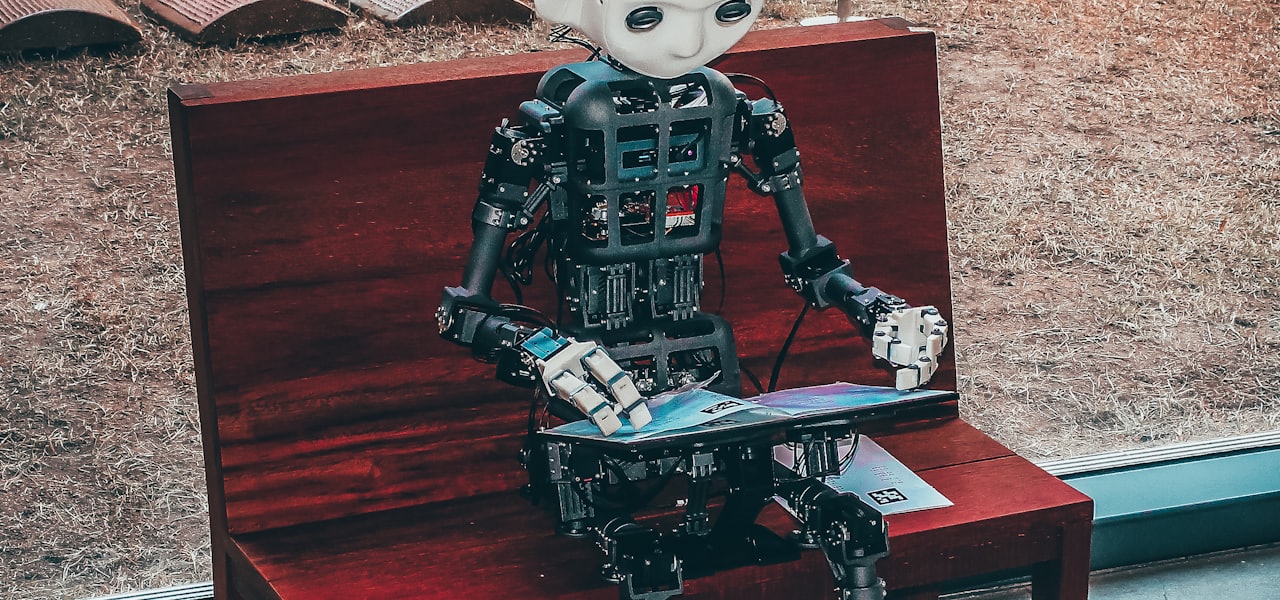
In computer science, a software agent is a computer program that acts for a user or another program in a relationship of agency. The term agent is derived from the Latin agere (to do): an agreement to act on one's behalf. Such "action on behalf of" implies the authority to decide which, if any, action is appropriate. Some agents are colloquially known as bots, from robot. They may be embodied, as when execution is paired with a robot body, or as software such as a chatbot executing on a computer, such as a mobile device, e.g. Siri. Software agents may be autonomous or work together with other agents or people. Software agents interacting with people (e.g. chatbots, human-robot interaction environments) may possess human-like qualities such as natural language understanding and speech, personality or embody humanoid form (see Asimo). Related and derived concepts include intelligent agents (in particular exhibiting some aspects of artificial intelligence, such as reasoning), autonomous agents (capable of modifying the methods of achieving their objectives), distributed agents (being executed on physically distinct computers), multi-agent systems (distributed agents that work together to achieve an objective that could not be accomplished by a single agent acting alone), and mobile agents (agents that can relocate their execution onto different processors). == Concepts == The basic attributes of an autonomous software agent are that agents: are not strictly invoked for a task, but activate themselves, may reside in wait status on a host, perceiving context, may get to run status on a host upon starting conditions, do not require interaction of user, may invoke other tasks including communication. The concept of an agent provides a method of describing a complex software entity that is capable of acting with a certain degree of autonomy in order to accomplish tasks on behalf of its host. But unlike objects, which are defined in terms of methods and attributes, an agent is defined in terms of its behavior. Various authors have proposed different definitions of agents, these commonly include concepts such as: persistence: code is not executed on demand but runs continuously and decides for itself when it should perform some activity; autonomy: agents have capabilities of task selection, prioritization, goal-directed behavior, decision-making without human intervention; social ability: agents are able to engage other components through some sort of communication and coordination, they may collaborate on a task; reactivity: agents perceive the context in which they operate and react to it appropriately. === Distinguishing agents from programs === All agents are programs, but not all programs are agents. Contrasting the term with related concepts may help clarify its meaning. Franklin & Graesser (1997) discuss four key notions that distinguish agents from arbitrary programs: reaction to the environment, autonomy, goal-orientation and persistence. === Intuitive distinguishing agents from objects === Agents are more autonomous than objects. Agents have flexible behavior: reactive, proactive, social. Agents have at least one thread of control but may have more. === Distinguishing agents from expert systems === Expert systems are not coupled to their environment. Expert systems are not designed for reactive, proactive behavior. Expert systems do not consider social ability. === Distinguishing intelligent software agents from intelligent agents in AI === Intelligent agents (also known as rational agents) are not just computer programs: they may also be machines, human beings, communities of human beings (such as firms) or anything that is capable of goal-directed behavior. == Impact of software agents == Software agents may offer various benefits to their end users by automating complex or repetitive tasks. However, there are organizational and cultural impacts of this technology that need to be considered prior to implementing software agents. === Organizational impact === === Work contentment and job satisfaction impact === People like to perform easy tasks providing the sensation of success unless the repetition of the simple tasking is affecting the overall output. In general implementing software agents to perform administrative requirements provides a substantial increase in work contentment, as administering their own work does never please the worker. The effort freed up serves for a higher degree of engagement in the substantial tasks of individual work. Hence, software agents may provide the basics to implement self-controlled work, relieved from hierarchical controls and interference. Such conditions may be secured by application of software agents for required formal support. === Cultural impact === The cultural effects of the implementation of software agents include trust affliction, skills erosion, privacy attrition and social detachment. Some users may not feel entirely comfortable fully delegating important tasks to software applications. Those who start relying solely on intelligent agents may lose important skills, for example, relating to information literacy. In order to act on a user's behalf, a software agent needs to have a complete understanding of a user's profile, including his/her personal preferences. This, in turn, may lead to unpredictable privacy issues. When users start relying on their software agents more, especially for communication activities, they may lose contact with other human users and look at the world with the eyes of their agents. These consequences are what agent researchers and users must consider when dealing with intelligent agent technologies. === History === The concept of an agent can be traced back to Hewitt's Actor Model (Hewitt, 1977) - "A self-contained, interactive and concurrently-executing object, possessing internal state and communication capability." To be more academic, software agent systems are a direct evolution of Multi-Agent Systems (MAS). MAS evolved from Distributed Artificial Intelligence (DAI), Distributed Problem Solving (DPS) and Parallel AI (PAI), thus inheriting all characteristics (good and bad) from DAI and AI. John Sculley's 1987 "Knowledge Navigator" video portrayed an image of a relationship between end-users and agents. Being an ideal first, this field experienced a series of unsuccessful top-down implementations, instead of a piece-by-piece, bottom-up approach. The range of agent types is now (from 1990) broad: WWW, search engines, etc. == Examples of intelligent software agents == === Buyer agents (shopping bots) === Buyer agents travel around a network (e.g. the internet) retrieving information about goods and services. These agents, also known as 'shopping bots', work very efficiently for commodity products such as CDs, books, electronic components, and other one-size-fits-all products. Buyer agents are typically optimized to allow for digital payment services used in e-commerce and traditional businesses. === User agents (personal agents) === User agents, or personal agents, are intelligent agents that take action on your behalf. In this category belong those intelligent agents that already perform, or will shortly perform, the following tasks: Check your e-mail, sort it according to the user's order of preference, and alert you when important emails arrive. Play computer games as your opponent or patrol game areas for you. Assemble customized news reports for you. There are several versions of these, including CNN. Find information for you on the subject of your choice. Fill out forms on the Web automatically for you, storing your information for future reference Scan Web pages looking for and highlighting text that constitutes the "important" part of the information there Discuss topics with you ranging from your deepest fears to sports Facilitate with online job search duties by scanning known job boards and sending the resume to opportunities who meet the desired criteria Profile synchronization across heterogeneous social networks === Monitoring-and-surveillance (predictive) agents === Monitoring and surveillance agents are used to observe and report on equipment, usually computer systems. The agents may keep track of company inventory levels, observe competitors' prices and relay them back to the company, watch stock manipulation by insider trading and rumors, etc. For example, NASA's Jet Propulsion Laboratory has an agent that monitors inventory, planning, schedules equipment orders to keep costs down, and manages food storage facilities. These agents usually monitor complex computer networks that can keep track of the configuration of each computer connected to the network. A special case of monitoring-and-surveillance agents are organizations of agents used to automate decision-making process during tactical operations. The agents monitor the status of assets (ammunition, weapons available, platforms for transport, etc.) and receive goals from hi
ROUGE (metric)
ROUGE, or Recall-Oriented Understudy for Gisting Evaluation, is a set of metrics and a software package used for evaluating automatic summarization and machine translation software in natural language processing. The metrics compare an automatically produced summary or translation against a reference or a set of references (human-produced) summary or translation. ROUGE metrics range between 0 and 1, with higher scores indicating higher similarity between the automatically produced summary and the reference. == Metrics == The following five evaluation metrics are available. ROUGE-N: Overlap of n-grams between the system and reference summaries. ROUGE-1 refers to the overlap of unigrams (each word) between the system and reference summaries. ROUGE-2 refers to the overlap of bigrams between the system and reference summaries. ROUGE-L: Longest Common Subsequence (LCS) based statistics. Longest common subsequence problem takes into account sentence-level structure similarity naturally and identifies longest co-occurring in sequence n-grams automatically. ROUGE-W: Weighted LCS-based statistics that favors consecutive LCSes. ROUGE-S: Skip-bigram based co-occurrence statistics. Skip-bigram is any pair of words in their sentence order. ROUGE-SU: Skip-bigram plus unigram-based co-occurrence statistics.